
Warminster Township Resident Lookup Records
No official roll lists every Warminster Township resident. The useful record changes with the question. A Bucks assessment or tax result can connect a titled owner with a parcel and tax-mailing field. A recorded instrument puts party names and dates into a property chronology. Court, voter, vital, probate, business, and license sources answer narrower questions. A careful resident lookup uses the smallest reliable set of records, then stops once the identity question is answered.
| Record | What It Can Confirm | Custodian | Access Boundary |
|---|---|---|---|
| Assessment or tax record | Titled owner, parcel, situs, and tax-mailing field | Bucks Board of Assessment | Owner and mailing fields do not prove occupancy; web ownership can lag a deed. |
| Recorded land instrument | Party role, document chronology, and property description | Bucks Recorder of Deeds | Public research area and paid LANDEX route; documents do not create a current household list. |
| Voter record | An individual registration question through an official route | Pennsylvania elections | The status tool is not a browseable street directory. |
| Court docket | Party, role, court, case number, and dates | Pennsylvania UJS | Protected case categories and some civil or family material are excluded. |
| Vital or probate record | Historic identity, relationship, death, marriage, or estate lead | PA Vital Records and Bucks Register | Certificates and sensitive court matters have separate access rules. |
| Business or license record | Filing or credential affiliation | Pennsylvania PALS | A filing or license does not establish a residential location. |
Use the assessment route first only when an ownership connection is plausible. The county’s tax form accepts a surname, parcel number, or location address and keeps situs and mailing information separate. For a recent transfer, compare the assessment result with the Recorder because Bucks warns that its web ownership display can trail a recorded deed. A resident lookup is stronger when the parcel or legal description matches across the records, not merely when two results share a surname.
Note: Record labels describe what an office maintains, not every person connected with a property or family.
Warminster Township Owners and Residents Differ
A titled owner, a tax-mailing contact, and a resident are three different labels. The Bucks property systems can show a property’s situs, parcel identifier, owner field, and mailing data. A mailing field may identify the delivery point for a tax bill, a fiduciary, or another contact. It should not be recast as a statement that the person lives at the situs. Likewise, an owner field does not identify every adult who may be present at that property.
This distinction matters most with common names. Record the parcel number, the date displayed, and the exact party spelling. Then use a recent recorded document to test the property connection. The Board of Assessment uploads public data weekly and notes that deed recording can come first. That local timing gap is a useful warning: a recent deed is the better chronology check, while the assessment record remains useful for the parcel and tax context.
Same-name control. Do not merge records solely because two Bucks results share a name. Match a parcel, court role, date, legal description, or documented relationship before treating results as one person.
Warminster Township Resident Court Search
For a Warminster Township name question, Pennsylvania UJS Case Search is the public docket starting point for the covered appellate, criminal, magisterial, and Philadelphia Municipal Court categories. It is not a full-file search. Juvenile, sealed, expunged, limited-access, and specified civil Common Pleas matters can be absent. A no-result therefore does not establish that no court record exists, and a docket result does not establish a present address.
The documented Common Pleas participant route lets a person narrow a search before looking at case details. Select Bucks when the county is known, use the court office only where it fits, and capture a docket number before asking the filing court about records. The optional date of birth field can make a result incomplete if it was not associated with every case, so it is a narrowing tool rather than a stand-alone identity test.
| UJS / PACFile field | Use and verified behavior |
|---|---|
| Last Name | Practical primary field; full and partial matches are allowed. |
| First Name | Optional; full and partial matches are allowed. |
| Date of Birth | Optional narrowing field; may omit associated cases when absent from a record. |
| Court Type | Defaults to Court of Common Pleas; this participant search is not for appellate cases. |
| County | Optional selection; choose Bucks for a county-limited result or leave blank for statewide results. |
| Court Office | Optional after county selection, with criminal, juvenile, or family division choices. |
The UJS public Case Search screen below is the source interface for this Warminster Township resident lookup court step.
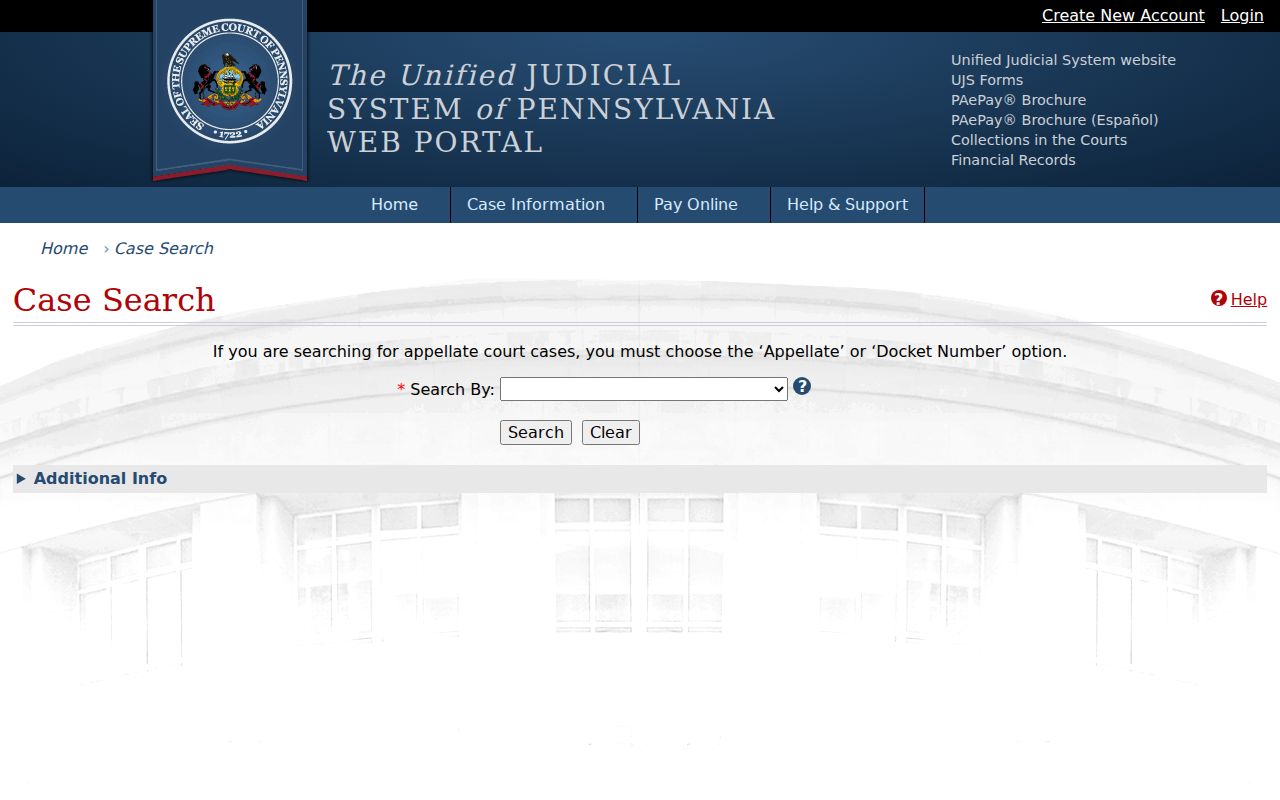
Use the screen as a route to public docket information, then retain the court, case number, party role, and date together rather than treating a name match alone as conclusive.
UJS Case Information distinguishes public docket access from secure paths and helps explain why a case detail can have different visibility rules.
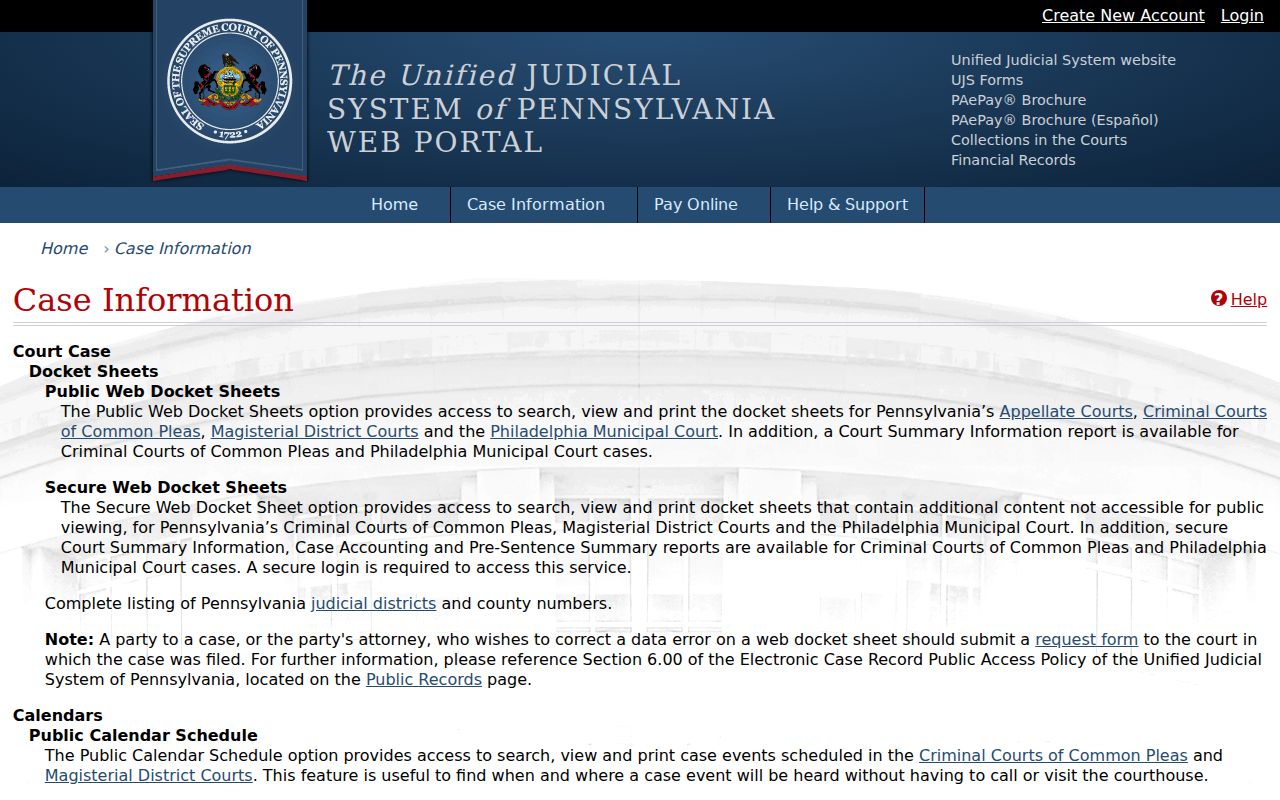
A public docket or case detail can show the case number, court placement, category, named party and role, event dates, filings, and scheduled-event information. Secure access can add material for qualified users, while confidential data and protected categories remain restricted.
Public docket detail inventory
| Result detail | What the UJS inventory supports |
|---|---|
| Case or docket number | Identifies the case and its court or county placement. |
| Case category and court office | Places the matter in the public court structure shown by the result. |
| Party and participant role | Shows the named participant in relation to the case, where public. |
| Filed, activity, and scheduled-event dates | Supplies time context without proving a current location. |
| Access status | Public docket sheets can be viewable or printable for designated categories; secure access has additional conditions. |
| Exclusions and redactions | Juvenile, expunged, limited-access, and confidential material can be unavailable or redacted. |
Warminster Township Resident Voter Limits
Pennsylvania’s Find Voter Registration Status route is intended for an individual registration check. It is not a means to browse a property, a block, or a list of Warminster Township residents. The official state guidance also gives a county-office alternative and the 1-877-VOTESPA phone channel. For local help, the Bucks County Board of Elections is the correct public office route.
The current voter-list request form is a separate process. It requires requester identification, a selected list type, a signature, and a written statutory affirmation. It offers a Public Information List, Street List, Walking List, and fuller export with different fields and limits. Under Election Code 25 P.S. § 1404, the form limits use to elections, political activities, or law enforcement. The individual status tool should not be turned into a broad resident lookup method.
The official voter-status form is shown here as the individual-check route, not as a directory.
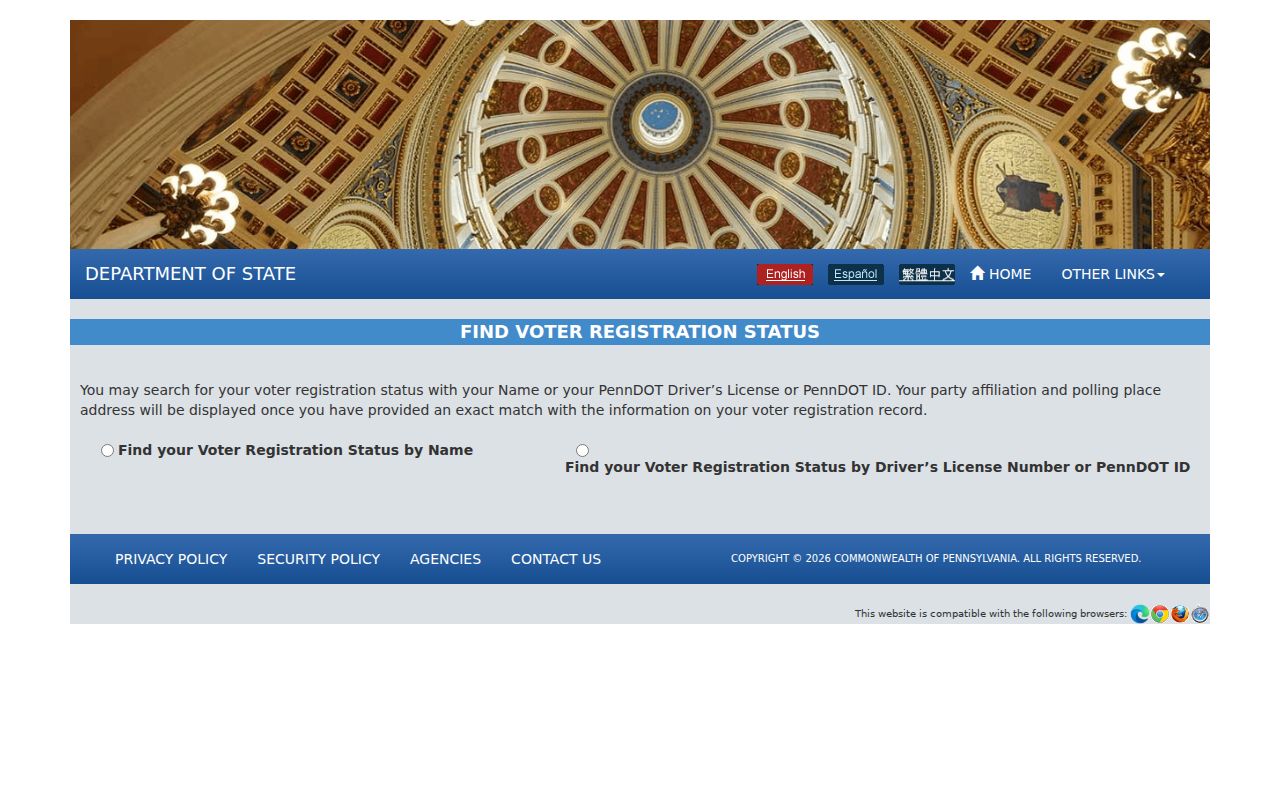
Registration information can be delayed, maintained, or protected, including through the Pennsylvania Address Confidentiality Program. It should be kept separate from parcel ownership and from any claim about a person’s current location.
Warminster Township Resident Vital Access
Vital records can help with an ancestor, a deceased person, or a relationship question, but their access clock is not the same as ordinary certificate ordering. Under 35 P.S. § 450.801, Pennsylvania birth records are public 105 years after birth and death records are public 50 years after death. The State Archives provides the historical, noncertified route, while the Division of Vital Records remains the path for certified copies. A historic index points to a record; it does not establish a living person’s address.
The Pennsylvania Vital Records ordering page directs current certificate requests through its official channels. The verified birth and death applications list a $20 certified-copy fee and a $10 online service fee. The State Archives public-originals route covers birth originals for 1906-1920 and death originals for 1906-1975, with a $5 noncertified copy or search and a stated two-to-three-week processing estimate. Confirm a current form before submitting an order.
The state’s Vital Records page is the source for the certificate-ordering channel shown below.
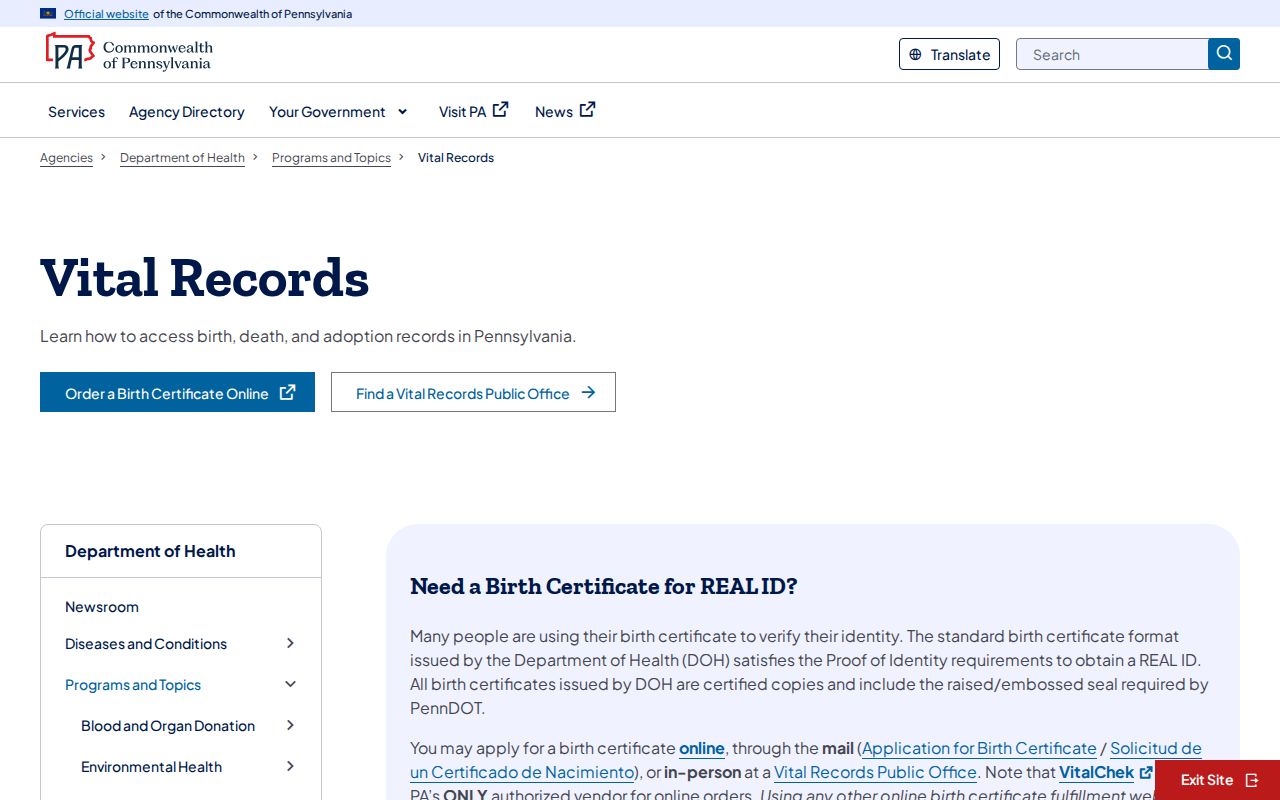
For the 1893-1906 Bucks period, the Register of Wills lists certified birth or death copies at $25. Marriage applications run through Bucks rather than the state vital office, and a divorce record follows the Common Pleas and Prothonotary route instead.
Warminster Township Resident Verification Steps
Verification is a sequence of small checks, not a search for one master result. Begin with the precise question and an official field that can be compared later. A property connection can anchor a name when parcel or legal-description data agrees. A court docket can add a time and role. An estate or historic vital result can add a documented family date. Keep each source within the limit the custodian gives it.
- Search the Bucks property route by known address or owner name and record the exact owner spelling, parcel number, situs, and mailing field separately.
- Match a recent Recorder document by party role and approximate date. Preserve the instrument, book or page reference, recording date, and property description.
- Use UJS only with the court, docket number, party role, and date context. A matching name alone is not enough.
- For a historic or deceased person, pair a State Archives vital result or Register index result with an estate, deed, census, or other dated record.
- Ask the custodian to correct a wrong record. Assessment timing goes to the Board or Recorder, while a UJS web-docket correction goes to the filing court.
- Docket
- The court’s numbered case record, which organizes parties, events, filings, and dates.
- Index and image
- An index is a finding tool. An image is a view or copy of the underlying document, which may have a separate fee or access rule.
- Certified copy
- A copy issued or authenticated by the legal custodian for the purpose and eligibility rules that office sets.
When a name question grows into an address-by-address problem, the separate Warminster Township streets resource follows the parcel chain rather than duplicating that work here.
Note: A useful verification log records source, date, office, search terms, identifier, and the specific fact each result supports.
Warminster Township Resident Probate Trail
A death date can open a careful estate or heir inquiry. The Bucks Register of Wills and Clerk of the Orphans’ Court handles probate, marriage licenses, estate matters, and related court roles. Its archive material reaches back to 1684. An estate record may identify a personal representative or give a relationship lead, but sensitive Orphans’ Court matters can be restricted by judicial order.
The Register’s genealogical route offers a paid name-index search for 1684-1950 at $25 per name. Its 1684-1987 index printout gives a name, death year, and index number; the later period also adds a death date. Complete microfilm is available in the Archive Research Center, originals from 1684-1936 can be reviewed onsite, and older offsite originals may need advance request. These access channels make probate a practical family-history step after a record identifies a deceased person.
Bucks marriage application records cover 1885 to the present. The research route lists $1 for an ordinary copy and $25 for a certified application record, with a self-addressed envelope for mail requests. Use the exact current Register form and its eligibility directions before requesting a copy.
Warminster Township Record Corrections
Each custodian controls its own correction path. A property display or ownership-timing question belongs with the Board of Assessment or Recorder. A voter concern belongs with Elections. A UJS docket concern goes to the filing court, and a vital amendment follows the Department of Health process. A change in one official record does not automatically update every other government system or a commercial compilation.
For a defined municipal record, Warminster’s Right-to-Know route accepts a specific written request and states a five-business-day response baseline. The Pennsylvania Right-to-Know Law is Act 3 of 2008, 65 P.S. §§ 67.101-67.3104. The current Office of Open Records schedule, adopted December 30, 2024, limits ordinary electronic, review, and redaction charges, though an office with a separate statutory fee can use that fee. Name the record category, address, date span, and custodian instead of asking for an open-ended person search.
Warminster Township Resident Lookup Privacy
Some address information is meant to stay protected. Pennsylvania’s Address Confidentiality Program gives eligible survivors a substitute mailing address that can reach court, voter, state-government, school, marriage-license, and utility records. It is administered by the Office of Victim Advocate and is part of an individual safety plan, not an invitation to search for a protected location. The program’s official contact is 800-563-6399.
Public access also has record-specific limits. Court files can withhold sealed, expunged, juvenile, limited-access, medical, financial, and family material. Motor-vehicle personal data is constrained by the Driver’s Privacy Protection Act, 18 U.S.C. §§ 2721-2725. A recorder’s public document is not permission to republish protected identifiers. For a professional identity question, PALS can verify a license status or disciplinary history, but it does not prove a person’s residential presence.
Lawful use. Use official Warminster Township records for personal, historical, family, estate, civic, or safety questions. Do not use a name, address, docket, or registration result to stalk, harass, intimidate, or harm another person.