
Warminster Township City Directory Collections
Warminster Township is not documented in the research as having one self-titled annual city-directory series. That is an important limit, not a dead end. The useful local route begins with a catalogue check at the Township library, Bucks County Free Library, the Mercer Museum Research Library and Archives, and local historical organizations. A city directory can be a strong dated clue, but only after its title page, edition, publisher, and access conditions are confirmed. The research located county and regional collections that may place Warminster in a wider Bucks County or Warminster-Hatboro-Willow Grove context.
| Collection or source | Years | Where held | Access and use |
|---|---|---|---|
| Warminster Township Free Library resources | Catalogue run not retrieved | Warminster Township Free Library | Ask staff to verify directory, telephone-book, yearbook, newspaper, and local-history holdings. |
| Bucks County Free Library family-history resources | Dates depend on the item | Bucks County Free Library | Ancestry Library Edition includes historical directories; local-history items may be placed at a branch for in-library use. |
| Business Directory and Gazetteer of Bucks County, Pennsylvania | 1871 | Confirmed historical reference | Inspect the volume before asserting a Warminster entry or field format. |
| Bucks County Directory | 1894 | Confirmed historical reference | County-wide reference, not proof of a Township household without entry inspection. |
| Farm Journal Farm and Business Directory of Bucks County | 1914 | Confirmed historical reference | Check the original or a reliable scan for coverage, publisher notes, and local entries. |
The collection table identifies paths that are documented, not a promise that each book lists every Township household. A library catalogue establishes an edition and call number. A title page establishes the publisher and year. An opened entry establishes what that specific book printed. Those distinctions protect a family-history search from turning a useful regional directory into an unsupported claim about Warminster Township.
Note: A verified directory listing is a dated lead, so retain its edition, page, and the exact spelling shown before comparing it with another record.
Verify a Warminster Township City Directory First
Before quoting a volume, ask the holding library or archive for the complete title, publisher, year, edition, call number or box reference, and whether the item is available onsite or through a database. Warminster Township Free Library is the immediate local contact point. Its research-and-learning information identifies Ancestry Library Edition for in-library use and HeritageQuest or Heritage Center material that includes census, Revolutionary War, and name-catalog sources. The Library can also confirm whether a requested historical telephone book, reverse directory, yearbook, or newspaper is actually present.
Warminster Township Free Library research resources provide the documented local route, while the library phone listed by the Township is 215-672-4362. A request is clearest when it names a surname, an approximate year, a town or road variant, and the kind of volume sought. Ask whether the catalogue record has a publisher and edition note, whether an item is in-library only, and whether scanning or photography rules apply. Do not treat an older web handout as a substitute for that item-level check.
For a regional search, Bucks County Free Library's family-history resources identify historical directory volumes within Ancestry Library Edition and HeritageQuest coverage. Its local-history collection includes hundreds of items and can send in-library-use material to a local branch. That access channel is useful when an online name search ends without an image, edition, or page citation.
Warminster Township Historical Directory Leads
The Township's digitized History of Warminster Township, The First 275 Years is a research lead rather than a replacement for a confirmed city directory volume. It was prepared for the 275th anniversary, credits Township historian Paul C. Bailey, and builds on an original 1960 compilation updated for the 1986 anniversary publication. It brings together named families, early cemetery notes, property-history snippets, maps, photographs, and institutional history. A surname or place found there can help form a search question for deeds, probate, census, church, or cemetery records.
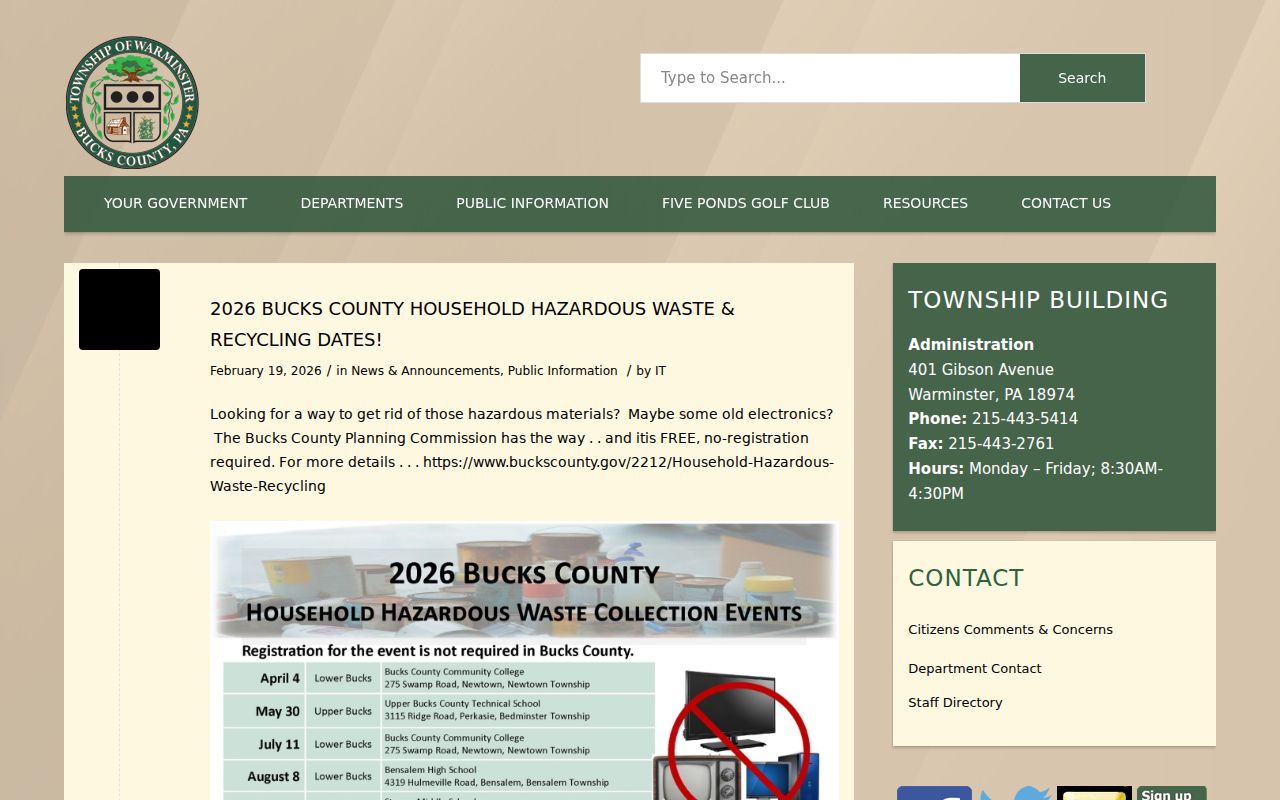
The Township's public-information collection also points to historical-preservation work and old burial places. The image below records that official history resource. It is most useful for placing a family or road in local context before turning to a dated primary source.
Historic narrative can suggest a name, site, or time period, but it does not establish a present or past household address by itself. Match any lead to a title-page citation, a recorded document, a census image, or a repository item before treating it as evidence.
Craven Hall and the Warminster Township Paper Trail
Craven Hall offers a distinct local records story. The University of Pennsylvania finding aid describes the Craven Hall Historical Society collection as material about Warminster and nearby places, including account and ciphering books, photographs, tax ledgers, deeds, documents, maps, ephemera, and material from local people, families, and organizations. It is a collection-level description, not an online name index. That means a finding-aid hit should lead to an appointment or a request for box, folder, date, restriction, and reproduction details.
The Craven Hall finding aid is especially helpful where a modern city directory cannot reach rural or farm-era descriptions. A tax ledger can identify a taxpayer or landholder. A deed can add a legal description. A map can help bridge an old village, farm, or road label to later parcel research. The finding aid makes clear why the archive should be queried at item level rather than treated as a searchable household list.
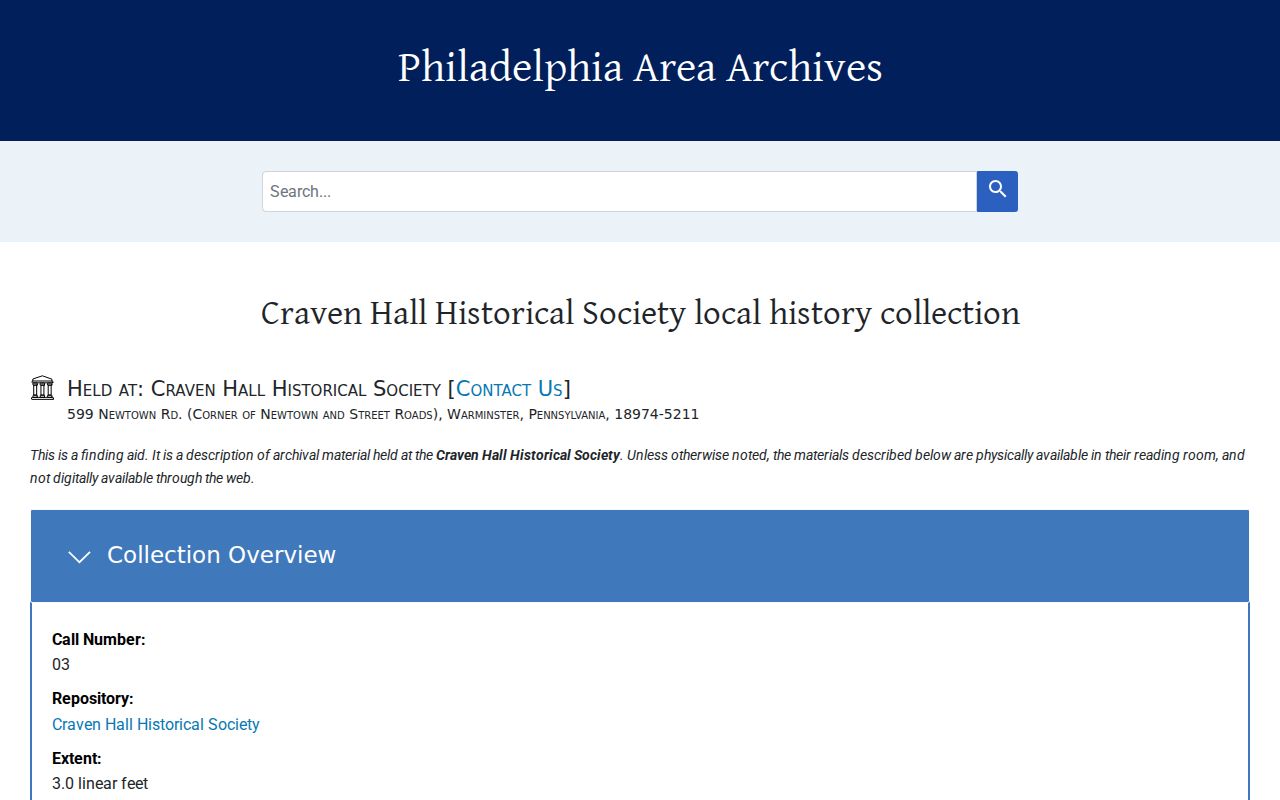
Warminster was established in 1711 according to the historical note in the finding aid, and its local record trail reaches well before modern directory formats. The archive can provide context for a family or property trail, while county deeds and estate records remain the place to confirm a dated legal or ownership event.
Reading a Verified Warminster Township City Directory Entry
No actual Warminster Township entry was located in an official digitized collection during the research sweep. The right response is to inspect a confirmed volume before describing its abbreviations or fields. When a volume is opened, record what the entry actually prints and photograph or cite the title page and abbreviation key along with the entry. A publisher may organize an alphabetical section differently from an address-ordered section, and its marks cannot be assumed from a volume made for another place or year.
| Name line | Capture spelling, initials, cross-reference, spouse, or widow notation only if it appears in the confirmed entry. |
|---|---|
| Address line | Separate a street address from a business address or telephone listing when the volume makes that distinction. |
| Other printed marks | Transcribe any ownership or cross-reference notation only where the book's own key explains it. |
| Order of entries | Determine whether the section runs name to address or address to listed occupant by inspecting the headings. |
| Citation | Keep publisher, edition, year, page image or page number, and repository access note with the transcription. |
- Criss-cross directory
- An address-ordered directory section that may connect a printed address to its listed occupant for that edition, if the volume contains one.
- Householder index
- An index organized around a household name when the publisher provides that arrangement; its exact scope must be checked in the volume.
- Abbreviation key
- The publisher's explanation of its shortened terms and symbols, usually essential before interpreting an entry.
For a current name or address verification after a historical lead is confirmed, use the separate Warminster Township resident lookup route. It relies on modern official records and should not be used to rewrite what an older directory did or did not list.
Warminster Township Directory, Census, and Deed Snapshots
A verified directory, a federal census, and a recorded deed answer different questions. A directory can show a listed name or address at the time of that edition. A census is a dated household snapshot, not a continuous address roll. A deed traces a recorded ownership transaction and may omit renters, adult children, or other people living at an address. Using the three sources together produces a stronger local history than forcing one type of record to answer every question.
| Source | Best use | Warminster Township caution |
|---|---|---|
| Verified directory or telephone book | Dated listed name or address clue | No local annual run or reverse-directory run was verified in the research. |
| Federal census | Household, age, birthplace, and Township context | Public releases reach 1950 as of 2026; enumeration descriptions may not match a modern address. |
| Recorded deed | Ownership chronology and legal-description trail | Ownership is not the same as complete household occupancy. |
Older Warminster research also needs a date-specific map. The Township's rural and farming history means a place may appear under a farm, village, road, or legal-description reference rather than a current street number. No official source in the research established a dated Township renumbering project, so an apparent address mismatch calls for a map, deed, and municipality check instead of a guess.
Trace a Warminster Township Household Through City Directories
A household trail begins with a reliable anchor, usually a precise current address and Bucks parcel number, then moves backward one dated record at a time. Directory work belongs in the middle of that chain, after the volume has been verified and before its spelling or address is treated as settled. A name disappearing from a book can mean a move, death, omission, or a different editorial rule. It does not prove one outcome without a second source.
- Record the current situs address, parcel identifier, owner field, mailing field, and legal reference separately in the Bucks assessment or tax system.
- Locate the recent acquisition deed through the Recorder's research route, then follow grantor and grantee names with an approximate year.
- Check the released census for the relevant Township or enumeration district, using family patterns as a cross-check rather than an address guarantee.
- Ask a library or historical organization for the confirmed directory, telephone, or reverse volume nearest the target year, then keep the title page, key, and page citation.
- Use probate indexes, obituaries, cemetery or church sources, and marriage applications to explain transitions, then return to deeds for the ownership trail.
The Bucks Register of Wills genealogical and archival route adds another bridge. Its Archive Research Center holds complete microfilm of 1684-forward files; originals from 1684 through 1936 can be reviewed onsite, while many other originals need advance request. County index information can connect a death date or family name to estate material, but court-access limits still apply to sensitive files.
Note: Keep each source as a dated observation, because a directory, census, deed, and estate paper may capture different people and different moments.
Warminster Township Directory Timing and Gaps
The evidence supports a long local records timeline, but not a continuous city directory publication line. Bucks Recorder records reach 1684, and the Register of Wills describes records dating to 1684 with archive microfilm and onsite original access for defined eras. The Township's published 275-year history provides local context, while Craven Hall preserves maps, deeds, tax ledgers, and other materials whose individual dates vary. Each source fills a different kind of gap.
- 1684 forward: Bucks recorded-land and Register records provide county-level documentary paths.
- 1711: The Craven Hall finding aid's historical note places the establishment of Warminster in the local chronology.
- 1960 and 1986: The Township history was originally compiled in 1960 and later updated for the 275th anniversary publication.
- 2026 research status: No exhaustive online item-level Warminster city-directory or reverse-directory run was verified.
The practical rule is simple: preserve gaps. If a verified volume has not been located for a target year, say so in the research notes and use deeds, census, map, estate, and archive channels that are documented for that period. A careful gap is more useful than a falsely smooth household timeline.